

The Evolution of the Concept of Luxury: How Prada Redefined Contemporary Fashion
In the global fashion landscape, very few names evoke the same level of intellectual respect and avant-garde charm as Prada. From a historic Milanese leather goods workshop to a pillar of contemporary visual culture, the fashion house has transformed the very concept of luxury, making it cerebral, conceptual, and, above all, a mirror of its times.
But what is the secret behind this brand's timeless success?
From Origins to "Ugly Chic": Miuccia's Revolution
Founded in 1913 by Mario Prada as a luxury luggage store in the Galleria Vittorio Emanuele II in Milan, the decisive turning point for the company came in the late 1970s with the entry of Miuccia Prada, the founder's granddaughter, and businessman Patrizio Bertelli.
Miuccia Prada has never considered herself just a designer, but a keen observer of society. In 1984, she made her first true act of stylistic rebellion: she launched the black nylon backpack (Vela). In an era dominated by opulence and ostentatious leather, Prada elevated a humble, industrial, and utilitarian material to an icon of high-end fashion. This was the birth of intellectual minimalism.
From that moment on, the brand overturned traditional aesthetic canons by introducing the concept of "Ugly Chic":
-
Non-conformity: Bold color combinations, retro geometric prints, and deliberately severe silhouettes.
-
Redefining femininity: A never-shouted sensuality, playing on layering and the contrast between masculine and feminine.
The Power of Icons: Accessories That Make History
If Prada clothing dictates the rules of cultural conversation, accessories are the true catalysts of global desire. In addition to the aforementioned nylon (now strictly Re-Nylon, a sustainable version made from regenerated nylon yarn), the fashion house has created some of the most collected pieces ever:
-
The Galleria Bag: In Saffiano leather, a timeless classic that combines craftsmanship and functionality.
-
The Monogram Loafers: Moccasins with chunky soles and the iconic triangular logo, which have become a staple of contemporary street style.
-
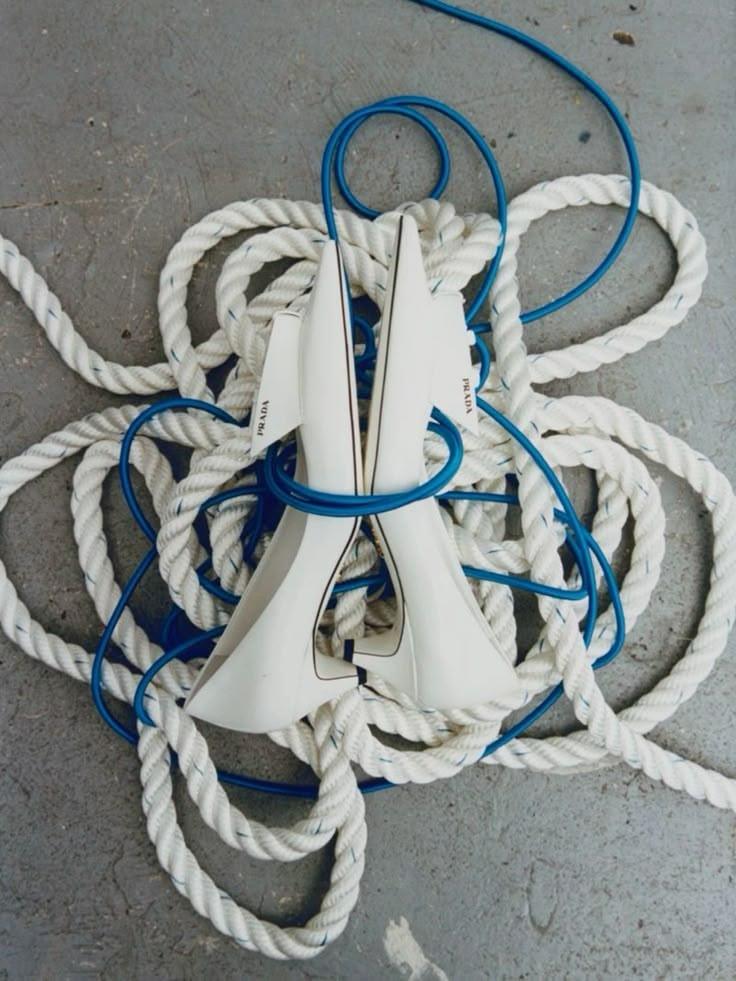
Sculptural shoes and runway shows: From geometric wedges to sharp-toed pumps, every Prada shoe is a piece of design.
The Co-Creative Era: The Meeting of Miuccia Prada and Raf Simons
In 2020, the brand opened a new, exciting chapter in its history with the appointment of Raf Simons as co-creative director alongside Miuccia Prada. A unique experiment in the world of high fashion: two brilliant minds, with different backgrounds but a similar vision, collaborating to shape the future of the brand.
The result? A perfect fusion of Miuccia's conceptual and bourgeois approach with Simons' youthful, graphic, and subculture-influenced aesthetic. Their collections are a triumph of tailored coats, modernized full skirts, archival graphics, and the ubiquitous triangular logo, reinterpreted each time in macro or micro versions.
"Fashion is an instant language." — Miuccia Prada
More Than Fashion: Fondazione Prada and Cultural Impact
Limiting Prada to the runways would be reductive. Through the Fondazione Prada in Milan, the brand has established itself as one of the most important cultural institutions in the world for contemporary art, cinema, and philosophy.
This deep connection with art is reflected in every collection: Prada doesn't just dress the body, it dresses thought. Choosing Prada means embracing a conscious aesthetic, made up of historical references, a commitment to sustainability, and a gaze always directed towards the future.
In a fashion world that moves fast and often repeats itself, Prada remains a solid benchmark. It doesn't follow trends: it intercepts them, deconstructs them, and ultimately, dictates them.

